
Cheap Car Insurance for Nurses
Top 5 Insurers, Best Discounts & How to Save More: Compare nursing-related quotes, and find ways to lower your car insurance costs.
Compare Quotes in 2 Minutes
Powered by:

 Secured with SHA-256 Encryption

Bill Jones — insurance content contributor
Are you a nurse looking for the cheapest car insurance? With a little research and quote comparison, nurses can often save 20% or more on their auto insurance. Many carriers treat nurses as lower-risk drivers, and some reward them with occupation or professional-group discounts. The catch is that these discounts are usually modest. The biggest savings for most nurses come from comparing insurers, stacking discounts, and choosing the right car and coverage.
This guide to cheap car insurance for nurses covers the cheapest insurers for nurses, the top discounts, average rates, the cheapest cars to insure, and what nurses under 25 can do to cut costs.
Quick answer: Nurses typically save a few percent to about 10% through occupation or group discounts. Based on the average rates we reviewed, USAA (for eligible military-affiliated nurses), GEICO, and Nationwide were the cheapest large insurers. Your rate still depends on your state, record, vehicle, and coverage, so compare at least three to five quotes.
Key takeaways
- Nurses pay slightly less than the average driver, but the occupation discount alone is small.
- Affinity discounts through groups like the American Nurses Association (ANA) can be larger, but they usually require a paid membership.
- Night-shift nurses should be careful with telematics programs that penalize late-night driving.
- Compact SUVs and small crossovers are consistently among the cheapest vehicles to insure.
- Nurses under 25 pay more, but student discounts, parental policies, and the right insurer can close much of the gap.
Average Car Insurance Rates for Nurses
Nurses pay slightly less than the average driver. Here is what the data shows.
Premium by occupation (The Zebra): nurses pay about $1,432 a year (about $119 a month). The generic “other” category pays $1,470. That works out to roughly $19 less per six-month premium. Military drivers paid the least in the same table, at $1,416.
National averages (Insurify): full coverage averages about $187 a month and liability-only about $99 a month. Nurses who qualify for group discounts may pay less than these averages.
Typical nurse savings: estimates vary widely. Policygenius found an average of $67 a year on full coverage (about $5 a month), with Liberty Mutual the highest at $144 a year. GEICO and Progressive offered $24 to $47 off six-month premiums in MoneyGeek’s research. MoneyGeek’s broader estimate is 3% to 15%.
These figures differ because each study used different drivers, vehicles, locations and insurers. The consistent message is that the occupation discount alone is modest, and shopping around is where the real savings are.
What moves your rate more than your job:
- Location. Insurify’s state averages for full coverage range from under $100 a month in some states to over $300 in others. A nurse in New Hampshire and a nurse in Maryland face very different prices.
- Driving record. A single at-fault accident can erase years of discounts.
- Credit history. In most states, insurers can use credit-based insurance scores.
- Annual mileage. Insurify notes that traveling nurses who log many miles may be rated higher.
- Vehicle and coverage level. More on this below.
Top 5 Cheapest Car Insurance Companies for Nurses
The rates below are average monthly premiums for nurses from The Zebra’s analysis of auto insurance rates. Your own quote will differ.
| Rank | Insurer | Avg. monthly premium (nurses) | Nurse-specific perk |
|---|---|---|---|
| 1 | USAA | $83 | Military-affiliated members only |
| 2 | GEICO | $95 | Partnerships with nursing groups, including AWHONN and HOSA |
| 3 | Nationwide | $97 | ANA partnership |
| 4 | Progressive | $127 | Professional discount in some states |
| 5 | Farmers | $130 | Affinity discount, about 5% per MoneyGeek |
Source: The Zebra. State Farm ($135), Allstate ($160), and Liberty Mutual ($162) ranked higher on price in the same data set.
1. USAA
USAA posted the lowest average premium in The Zebra’s data, at $83 a month. The catch is eligibility. USAA serves military members, veterans, and their families. If you or a close family member served, get a USAA quote first. It also ranked first among car insurers in The Zebra’s customer satisfaction survey.
2. GEICO
GEICO is the cheapest option for most nurses who don’t qualify for USAA. It also partners with a long list of professional organizations. According to ValuePenguin and MoneyGeek, those include the Association of Women’s Health, Obstetric and Neonatal Nurses (AWHONN), the American Society of Registered Nurses (ASRN), and Health Occupations Students of America (HOSA), which is useful for student nurses. MoneyGeek reports occupation-based savings between 3% and 15%.
3. Nationwide
Nationwide averaged $97 a month for nurses in The Zebra’s data. The ANA partners with Nationwide Insurance. Nationwide’s SmartRide telematics program advertises savings of up to 40% for safe drivers, though results vary and night-shift drivers should read the fine print first.
4. Progressive
Progressive averaged $127 a month. MoneyGeek lists it among insurers that extend a professional discount to nurses, and its Snapshot telematics program may help day-shift drivers. Insurify notes that customers praise its buying process and coverage options but often complain about rate increases at renewal.
5. Farmers
Farmers averaged $130 a month. It runs an affinity discount program, reported at about 5%, that covers nurses along with other professions such as teachers and police officers. Farmers is available in most states, so it is a useful quote to run even when it isn’t the cheapest.
Regional insurers worth checking. California Casualty offers nurse-specific features, including lower deductibles for damage within 500 feet of your workplace (a perk that matters in busy hospital parking lots). COUNTRY Financial and Plymouth Rock also offer occupation or group discounts in certain states.
The Overall Cheapest Car Insurer for Nurses
For most nurses, GEICO is the cheapest overall pick. USAA had the lowest average premium in our data, but it is restricted to the military community, so it isn’t an option for most drivers. GEICO had the lowest average among the broadly available insurers we reviewed, at $95 a month. It also stacks nursing-group discounts on top of its standard savings.
There are two caveats. First, other data sets name other winners. Insurify’s own analysis lists Safeco, USAA, and State Farm among the cheapest for nurses. Different companies pull quotes for different driver profiles, vehicles, and coverage limits, so the “cheapest” label depends on the methodology.
Second, an insurer that offers a nurse discount is not always the cheapest. Jerry points out that the companies offering nurse discounts may not have the lowest rates overall. Policygenius found that Liberty Mutual gave the biggest nurse discount in its test ($144 per year), yet Liberty Mutual’s average premium in The Zebra’s data was among the highest.
The practical takeaway: get a quote from GEICO, a second quote from an insurer that partners with your nursing organization, and a third from a regional or low-cost carrier like Safeco or State Farm. Then choose the lowest price for the coverage you actually need.
Pro Tip #1: Ask for the discount by name, and check the math before you join anything.
Many insurers don’t advertise their nurse discounts, so don’t rely on the online quote form alone. Call an agent and ask what they offer for nurses, healthcare workers, and members of groups like the ANA or ASRN. If a discount requires a membership, subtract the annual dues from the yearly savings. Join only if you come out ahead.
Top 10 Car Insurance Discounts for Nurses
The ranges below come from MoneyGeek’s estimates and each insurer’s published programs. Actual savings depend on the insurer, state, and driver profile, and not every discount is available everywhere.
1. Occupation (nurse) discount
Some insurers give a discount simply because you’re a nurse. Typical estimates run from 3% to 15%, though The Zebra’s data suggests the realistic savings from occupation alone are small (about $19 per six-month premium). Always tell the agent or quote form that you’re a nurse, because some insurers don’t advertise this discount.
2. Professional organization (affinity) discount
This is often the largest nurse-specific discount. The ANA says members may save up to $947 a year through its Liberty Mutual partnership. The cost is your membership dues, which ValuePenguin puts at roughly $50 to $300 a year. Join only if your expected insurance savings exceed the dues.
3. Multi-policy (bundling) discount
Combining auto with renters, condo, or homeowners insurance is one of the most reliable ways to save. MoneyGeek estimates 12% to 25% on the auto portion. Many nurses carry renters insurance anyway, so this is a natural fit.
4. Safe driver discount
Three to five years without accidents, claims, or violations can earn a discount that MoneyGeek puts at 10% to 25%. Guard your record by avoiding tickets and fatigue-related mistakes after long shifts.
5. Defensive driving course
Completing a state-approved course can save about 5% to 15%. Many are available online and fit around shift work. Confirm your insurer accepts the course before you pay.
6. Telematics (usage-based) discount
Programs like Progressive Snapshot, Nationwide SmartRide and State Farm’s Drive Safe & Save can reward careful drivers. For night-shift nurses, there is a trap. ValuePenguin warns that programs often track time of day, and driving between roughly midnight and 5 a.m. can reduce your discount or raise your rate. If you work nights regularly, ask how the program treats late-night trips before enrolling.
7. Good student discount
Nursing students with a 3.0 GPA or higher may qualify for 10% to 20% off, according to MoneyGeek. You’ll typically need to send a transcript.
8. Pay-in-full discount
Paying a six-month or annual premium upfront can save around 3% to 8%. It works well if you receive a bonus, tax refund, or shift differential.
9. Vehicle safety feature discount
Anti-lock brakes, anti-theft systems, automatic emergency braking, and lane-departure warning can all qualify. Estimates run from 5% to 15%.
10. Paperless billing and autopay
This is a small discount (about 2% to 5%), but it is easy to claim and stacks with everything else.
Stacking. MoneyGeek suggests that pairing a professional discount with a clean record could reach about 20% in total, and combining organization membership with a home-and-auto bundle could reach about 25%. Treat those as best-case figures rather than guarantees.
Proof you’ll need. Most insurers accept a nursing license number, hospital ID badge, recent pay stub or letter from your employer, plus proof of membership if the discount comes through an organization.
Top 3 Cheapest Cars To Insure For Nurses
The vehicle you drive can matter as much as any discount. Cars with strong safety ratings, lower repair costs, and low theft rates tend to be cheaper to insure, and recent rankings are dominated by compact SUVs. One 2026 analysis pegs the gap between the cheapest and most expensive models at about $4,400 a year.
Rankings differ by data source, but these three models appear repeatedly.
1. Honda CR-V
The Honda CR-V and HR-V tied as the cheapest new cars to insure in 2026, at $161 a month in one analysis. CarInsurance.com’s study put the CR-V’s average full-coverage premium at $2,316 a year. It’s a practical, reliable choice for nurses with long commutes or equipment to carry.
2. Subaru Crosstrek
CarInsurance.com’s 2026 study ranked the Subaru Crosstrek the cheapest to insure, at $2,299 a year for full coverage, with the Jeep Wrangler and Honda CR-V close behind. Its standard safety features and all-wheel drive appeal to nurses commuting in winter weather.
3. Honda HR-V
The HR-V ties the CR-V in monthly cost in the Insurance.com data, at $161 a month. It is a smaller, lower-priced alternative for nurses who want a compact crossover without a full-size SUV’s cost.
Honorable mentions: the Volkswagen Tiguan ($165 a month in the same analysis), the Subaru Legacy (the cheapest sedan at $179 a month) and the Ford Maverick (the cheapest truck at $177 a month).
A note on methodology. Each study uses different drivers and locations, so don’t expect identical numbers. The pattern is what matters: compact SUVs have historically been the cheapest group to insure, because their buyers tend not to prioritize horsepower. Before you buy, get an insurance quote for the exact trim you’re considering, and avoid sports cars and high-performance models, which are often rated as higher risk.
Cheapest Car Insurance for Nurses Under 25
Age is one of the biggest factors in pricing, and it can outweigh your occupation. Insurify reports that drivers under 25 pay an average of $258 a month for full coverage and $127 a month for liability-only. Bankrate’s data shows the same pattern, with full-coverage averages for 25-year-olds still above the national average and higher still for 20-year-olds.
The good news: new nurses and nursing students have several ways to bring that number down.
Insurers to quote first
- COUNTRY Financial, Auto-Owners, and USAA. Insurify named these three among the cheapest for drivers under 25. COUNTRY Financial and Auto-Owners are regional, so check availability in your state.
- GEICO, Travelers, and State Farm. Bankrate and Insurify both highlight these for young adults, and Insurify says Farmers, Travelers, and State Farm offer some of the best discounts for under-25 drivers.
- Compare.com’s data points to COUNTRY Financial as the cheapest average for young drivers, with rates starting around $61 a month, though your quote will depend on your profile.
Savings strategies for young nurses
- Use the good student discount. If you’re in nursing school with a 3.0 GPA or higher, you may save 10% to 20%.
- Join HOSA or a student nursing association. GEICO partners with HOSA for student nurse discounts, and the ASRN also has GEICO and AAA affiliations.
- Stay on a parent’s policy if possible. Multi-car and multi-driver policies are often cheaper than a standalone policy for a young driver.
- Pick a safe, modest car. A used compact SUV or sedan with good safety scores will usually cost less than a sporty first car.
- Raise your deductible. If you have an emergency fund, a higher deductible lowers your premium.
- Try telematics carefully. A safe young driver may earn real savings, but clinical shifts that put you on the road late at night can work against you.
- Take a defensive driving course. It can earn a discount and strengthen your record.
- Re-shop at 25. Bankrate reports that 25-year-olds pay about 39% less than 20-year-olds on average, so compare quotes again around your birthday and again after each year of clean driving.
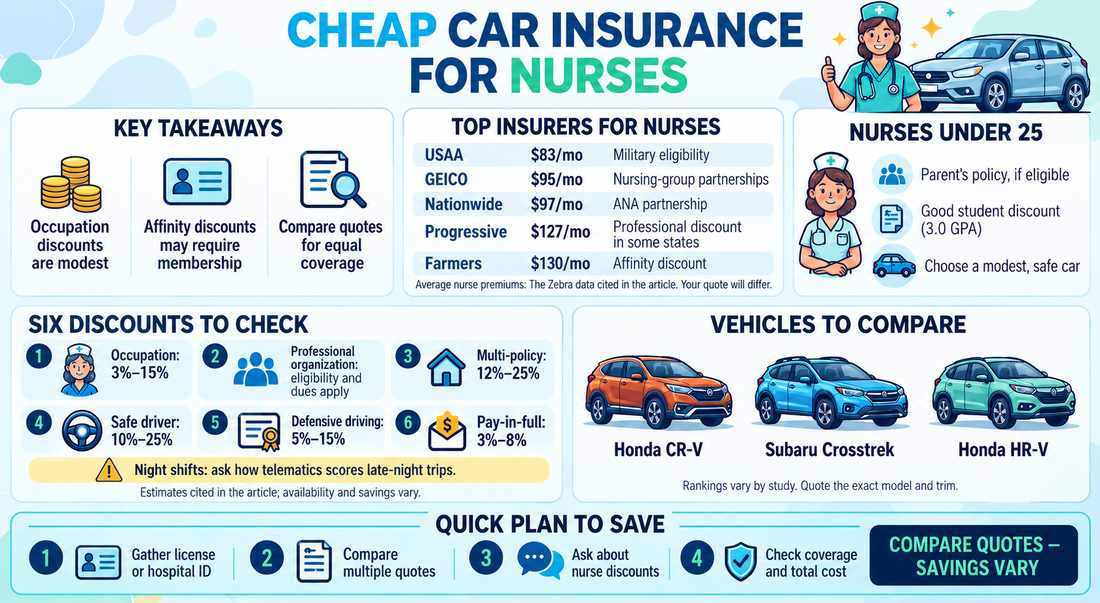
Pro Tip #2: Test a telematics program before you commit to it, especially on nights.
Many programs penalize late-night driving, which can work against nurses on overnight shifts. Before you enroll, ask the insurer how it scores trips between midnight and 5 a.m. and whether you’ll lose your enrollment discount if your score is poor. If your shifts put you on the road at those hours, a flat discount like bundling or pay-in-full is the safer way to save.
10 FAQs About Car Insurance for Nurses
1. Do nurses get a discount on car insurance?
Yes, but only with some insurers. Companies such as GEICO, Nationwide, Farmers, Liberty Mutual, AAA, and California Casualty offer occupation or affinity discounts. Availability varies by state.
2. Which company has the cheapest car insurance for nurses?
In our review, USAA had the lowest average ($83 a month) for those eligible, and GEICO ($95 a month) was the cheapest among broadly available insurers. Your best rate depends on your profile, so compare multiple quotes.
3. How much can nurses save?
Estimates range from about 3% to 15%, or roughly $24 to $47 per six months at some insurers. Affinity programs can add more, such as the ANA’s advertised savings of up to $947 a year on a bundled Liberty Mutual policy.
4. What proof do I need for a nurse discount?
Most insurers accept a nursing license number, hospital ID, pay stub or employer letter. If the discount comes through an organization, you’ll need proof of membership.
5. Is joining a nursing organization worth it for insurance?
Only if the savings beat the dues. ValuePenguin puts dues at about $50 to $300 a year. If membership saves you $200 or more annually on insurance, it can pay for itself, and you may also gain other benefits such as professional liability coverage.
6. Do student nurses get discounts?
Often, yes. Good student discounts (typically a 3.0 GPA or higher) can save 10% to 20%, and groups like HOSA partner with GEICO for student members.
7. Will working night shifts raise my rates?
Your work schedule doesn’t change standard discounts, but telematics programs can penalize late-night driving. If you work overnight, skip programs that charge heavily for late-night trips and ask insurers how their programs treat time of day.
8. Do travel nurses need a special policy?
Possibly. If you’re away from your car for long stretches, a per-mile policy or non-owner policy may be cheaper. Insurers also care about where the car is garaged, so tell your agent about your assignments.
9. Can I combine a nurse discount with other discounts?
Yes. Most insurers let you stack occupation discounts with bundling, safe-driver, paperless, and pay-in-full discounts. The combined savings can be significant, though no insurer guarantees a specific total.
10. Should I file a claim for minor damage?
It depends. MoneyGeek notes that filing a claim can raise premiums by 20% to 30% for up to three years, so paying out of pocket for small repairs (for example, under about $750) is often cheaper. For larger repairs, filing usually makes sense, and accident forgiveness can soften the impact.
The Final Word on Cheap Car Insurance For Nurses
Being a nurse can help you get cheap car insurance, but it is rarely the whole story. The occupation discount is useful, though modest. The real savings come from comparing quotes, joining a professional group only when the math works, stacking discounts, and choosing a safe, affordable vehicle.
Here is a simple plan:
- Gather your nursing license or hospital ID.
- Get quotes from GEICO, Nationwide, and at least one regional or low-cost insurer. Check USAA if you’re eligible.
- Mention that you’re a nurse and ask about every affinity and occupation discount.
- Bundle with renters or home insurance if you can.
- Choose coverage that fits your car’s value and your assets.
- Re-shop every year, and especially after major life changes like a new job, a move, or turning 25.
Rates change often, and the figures here come from published studies that use different methods, so treat them as estimates. Run your own quotes to find your best price. This article is for general information and is not financial or insurance advice. Compare the cheapest car insurance quotes for nurses in under five minutes. Get quoted now and see how easy it is to save with direct rates.
SOURCES
- Insurance Information Institute. “Nine ways to lower your auto insurance costs.” https://www.iii.org/article/nine-ways-lower-your-auto-insurance-costs
- National Association of Insurance Commissioners. “Credit-Based Insurance Scores.” https://content.naic.org/cipr-topics/credit-based-insurance-scores
- American Nurses Association. “ANA Personal Benefits.” https://www.nursingworld.org/membership/member-benefits/personal-benefits/
- GEICO. “Membership Discounts.” https://www.geico.com/save/discounts/organization-member/
- California Casualty. “Insurance Designed for Nurses.” https://calcas.com/nurses
Compare Quotes in 2 Minutes
Secured with SHA-256 Encryption
OUR WEBSITE

TRUST & AUTHORITY


Featured Articles
SEARCH
Looking for something specific? Use the search bar below to find answers to your questions!