
Prepaid Car Insurance
Learn how prepaid car insurance works, who it’s best for, which companies offer it, typical costs, and smart ways to save.
Compare Quotes in 2 Minutes
Powered by:

 Secured with SHA-256 Encryption
Prepaid car insurance has become easier to find in recent years as more drivers look for flexible payment options instead of large upfront bills or rigid billing schedules.
Instead of assuming you must lock yourself into a traditional 6- or 12-month payment schedule, prepaid car insurance may let you pay for coverage in advance, often in short, manageable time periods. For certain drivers, this flexibility can be the difference between being legally insured and going without coverage at all.
This article explains prepaid car insurance from the ground up, who it may work best for, which insurers or platforms may offer prepaid or prepay-friendly options, realistic cost considerations, how to save money, and answers to common questions people ask before choosing this type of policy.
What Prepaid Car Insurance Really Means
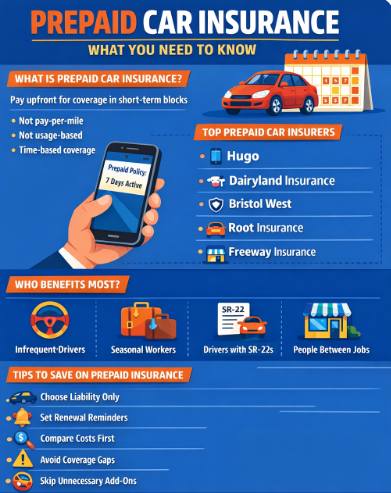
Prepaid auto insurance simply means you pay before coverage is active, rather than paying monthly for coverage after a policy has already started.
Coverage may be purchased in blocks of time, such as days, weeks, or months, depending on the insurer, product, eligibility rules, and state regulations. Even when a plan is advertised as prepaid, pay-as-you-go, or low down payment, coverage usually requires an approved payment or billing setup before the policy becomes active.
It is also important to understand what it is not:
It is not always the same as pay-per-mile insurance, where you are billed based on how much you drive. It is also not automatically usage-based insurance that monitors braking, speed, or phone use. Prepaid insurance is usually payment- or time-based, not necessarily behavior-based.
The core idea is control. You decide when coverage starts, how long it lasts, and when you renew it, as long as the insurer allows that structure in your state.
| Option | How it usually works | Best fit |
|---|---|---|
| Prepaid car insurance | You pay before coverage starts, sometimes for a shorter coverage period or with flexible renewal timing. | Drivers who need flexibility and want to control upfront payments. |
| Monthly payment plan | You pay installments on a standard policy, often after an initial payment. | Drivers who need continuous coverage and predictable billing. |
| Pay-per-mile insurance | Your price may depend partly on mileage or driving usage, depending on the program. | Low-mileage drivers who do not use their car often. |
How Prepaid Car Insurance Works in Practice
While details vary by company, the basic flow is usually consistent:
- You select the type of coverage you want, usually liability-only and sometimes full coverage.
- You prepay for a specific coverage period or choose a prepay-friendly billing option.
- Coverage activates immediately or on a scheduled date after the insurer accepts the payment and issues the policy.
- When the prepaid period ends, coverage may stop, renew, or require another payment depending on the policy terms.
Many prepaid or flexible-payment insurers operate digitally, meaning quoting, payments, policy changes, and proof of insurance may be handled through an app or online dashboard.

Why Drivers Choose Prepaid Car Insurance
Prepaid car insurance exists because traditional auto insurance does not work well for everyone. Some drivers face barriers that make standard payment schedules impractical or difficult to maintain.
Common reasons drivers choose this type of insurance include unstable income, difficulty affording large down payments, short-term vehicle use, or the need for immediate legal compliance. For others, it is simply about flexibility and avoiding long-term payment commitments.
The Real Costs of Prepaid Car Insurance
Prepaid car insurance is not always the cheapest option for full-year coverage. The cost per day or per month may be higher than a traditional policy when averaged over time. Where it becomes valuable is in short durations, irregular usage, or situations where payment flexibility matters more than the lowest annual cost.
Costs depend heavily on state laws, driving history, vehicle type, coverage limits, payment plan, and insurer eligibility rules. Liability-only policies are often cheaper than full coverage. Drivers with violations, lapses, or SR-22 requirements usually pay more.
The most important cost consideration is consistency. Prepaid insurance makes sense financially only when used intentionally, not as a default year-round solution without comparing the total cost.
Five Insurers or Platforms That May Offer Prepaid or Prepay-Friendly Car Insurance
Availability changes by state, underwriting rules, and product type. The companies below are examples of insurers or insurance platforms that may offer prepaid, pay-at-your-pace, flexible payment, low-down-payment, or app-based billing options. Always confirm the exact terms before buying a policy.
Hugo
Hugo is one of the more visible pay-at-your-pace car insurance providers in the United States.
Hugo allows eligible drivers to buy insurance in small time increments and manage coverage through a mobile app. It may work best for drivers who need short-term coverage or want maximum payment flexibility. It is not always ideal for drivers who need uninterrupted year-round insurance at the lowest possible total cost.
Dairyland Insurance

Dairyland offers flexible payment options that may be useful for drivers looking for lower upfront payment structures.
While not always marketed as prepaid insurance, Dairyland’s flexible payment options and support for certain higher-risk drivers can make it relevant for people who struggle with standard insurers. Dairyland may work best for drivers with violations, lapses, or SR-22 needs who still need legitimate, state-compliant coverage.
Bristol West
Bristol West, a member of the Farmers Insurance Group of Companies, focuses on auto insurance for a wide range of drivers, including drivers who may not fit standard preferred-insurance pricing. This insurer may be better suited for drivers with imperfect records than for bargain shoppers with clean histories.

Some Bristol West policies may offer flexible payment structures, making them functionally similar to prepay-friendly insurance for certain drivers.
Root Insurance

Root is technically more closely associated with usage-based, app-based insurance than prepaid insurance, but it is often compared with flexible digital insurance options.
Root generally uses app-based underwriting and digital policy management. It may work best for safe drivers who are comfortable with smartphone-based quoting and want simple online policy access without traditional agent involvement. Because app-based pricing and availability vary, drivers should review privacy permissions, payment timing, and state availability before applying.
Freeway Insurance

Freeway Insurance is not a direct insurer but an insurance broker that may help drivers compare options from multiple carriers.
Freeway is often used by drivers who need fast proof of insurance or who want help comparing carrier options. This option may work best for drivers who need quick coverage and do not qualify easily with mainstream insurers, but the actual payment structure depends on the carrier that writes the policy.
Who Prepaid Car Insurance Is Best For
Prepaid car insurance is best suited for drivers who do not drive daily, own a second vehicle, work seasonally, or experience income variability. It can also be useful for drivers between jobs, relocating, or temporarily needing insurance to register or reinstate a vehicle.
It is less suitable for daily commuters, high-mileage drivers, and households that need continuous, predictable coverage without the risk of missed payments or lapses.
Five Tips to Save on Prepaid Car Insurance
Using prepaid insurance strategically can make it affordable. Using it passively can make it expensive, especially if short-term payments add up to more than a standard policy over the same period.
Common Mistakes to Avoid
Many drivers assume prepaid insurance is cheaper by default. This is rarely true for full-year coverage. Another common mistake is allowing coverage to lapse unintentionally, which can create legal problems and may raise future insurance rates.
Prepaid insurance should be used deliberately, not reactively. Before choosing a policy, compare the total cost, renewal rules, cancellation terms, and whether the coverage period matches how you actually use the car.
Ten FAQs About Prepaid Car Insurance
What is prepaid car insurance? +
Is prepaid car insurance legal? +
Is prepaid car insurance cheaper than regular insurance? +
Can prepaid insurance cause a lapse in coverage? +
Does prepaid insurance affect my credit? +
Can I get full coverage with prepaid insurance? +
Is prepaid insurance the same as pay-per-mile insurance? +
Can prepaid insurance help high-risk drivers? +
Do prepaid insurers offer SR-22 filings? +
Who should avoid prepaid car insurance? +
Final Thoughts on Prepaid Car Insurance
Prepaid car insurance is not a universal solution, but it plays an important role in the insurance market. For drivers who need flexibility, short-term coverage, or relief from high upfront costs, it can be a practical and legal way to stay insured when the policy meets state requirements.
The key is knowing why you are choosing it. When prepaid insurance matches your lifestyle and usage patterns, it can work well. When it does not, a traditional policy will often be cheaper in the long run. Compare prepaid car insurance quotes where you live, review the total cost before buying, and choose coverage that keeps you legally insured without creating avoidable lapses.
References
Compare Quotes in 2 Minutes
Secured with SHA-256 Encryption
OUR WEBSITE

TRUST & AUTHORITY


Featured Articles
SEARCH
Looking for something specific? Use the search bar below to find answers to your questions!