
Cheap Car Insurance in GA With No Down Payment
Learn how Georgia drivers can find affordable auto coverage with no upfront costs.
Compare Quotes in 2 Minutes
Powered by:

 Secured with SHA-256 Encryption

Bill Jones — insurance content contributor
Drivers looking to get their vehicle covered with the lowest out-of-pocket costs possible may consider cheap car insurance in GA with no down payment. Auto insurance is required in Georgia, but for many drivers in the Peach State, the biggest pain point isn’t the monthly bill; it’s the initial payment.
That’s why many people search for more affordable options like “cheap car insurance in GA with no down payment.” The phrase generally describes policies or financing arrangements designed to reduce the amount a driver must pay at the start of coverage.
Many drivers in GA want to get on the road today without draining their bank account. But here’s the reality: Georgia law requires advance payment for the first 30 days of motor vehicle liability coverage before a policy is issued.[1] That means “no down payment” usually doesn’t mean completely free coverage at the start. In practice, it may describe a policy with a small initial payment or a financing arrangement that covers the amount due to the insurer.
This guide explains how to compare low-upfront-cost car insurance options in Georgia, with practical examples, tables, and charts that clarify the choices available.
CitizensInsurance.net is an independent insurance information website. It does not issue policies or guarantee rates, approval, coverage, or payment terms.

Five Options to Compare for Cheap Car Insurance in GA With No Down Payment
| Option | Provider or Service | Initial Cost | Why It May Fit a Low-Down-Payment Search |
|---|---|---|---|
| 1 | Georgia Farm Bureau | Quote required | A Georgia-focused insurer worth comparing; rates and installment options depend on the driver and policy. |
| 2 | Central Insurance | Quote required | Available through independent agents in Georgia; pricing and payment schedules vary by applicant. |
| 3 | Hugo | Availability varies | May provide flexible payment features where offered; confirm current Georgia availability and eligibility by ZIP code. |
| 4 | OCHO | May be $0 for approved applicants | May finance the amount due to the insurer so an eligible applicant can start coverage with little or no separate deposit. Approval and terms apply. |
| 5 | Direct Auto / Good2Go | Quote required | Companies serving non-standard or flexible-payment markets may offer lower initial-payment choices, but total policy cost should also be compared. |
*These are comparison examples, not a cheapest-company ranking or guaranteed offer. Rates, initial payments, financing approval, and availability vary by insurer, ZIP code, vehicle, coverage, driving history, and other underwriting factors.
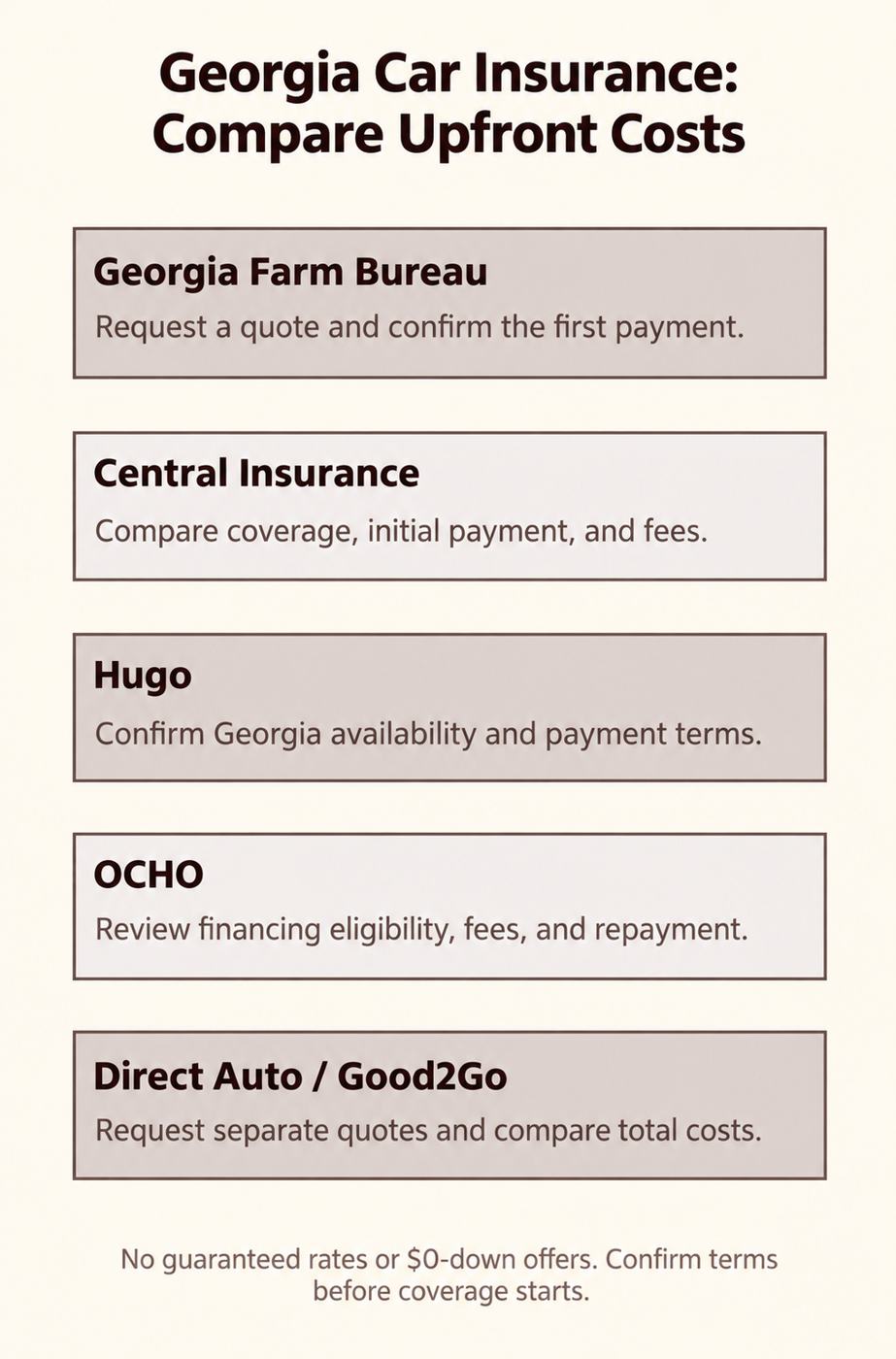
Compare the amount due before coverage starts, the total premium, installment fees, and any financing charges. Confirm availability and terms directly.
The Smartest and Cheapest Ways to Get Your Vehicle Covered in GA
A smart move when looking for the cheapest Georgia car insurance is to structure your policy carefully. Doing so can have a meaningful impact on the upfront cost. Here are several practical strategies that may help:
1. Consider liability-only if you own your car outright and can afford to repair or replace it yourself after a loss not covered by liability insurance.
2. Quote with multiple carriers — rates can vary widely even within the same ZIP code.
3. Stack eligible discounts: autopay, paperless billing, safe driver, and bundling discounts.
4. Ask about monthly installments and the exact amount due to start coverage.
5. Consider deposit financing if you truly need little or no separate payment at checkout, while reviewing all financing terms.
6. Bind new coverage before the old policy ends. Georgia treats 10 or more consecutive uninsured days on the state record as a lapse, so continuous coverage is the safest approach.[4]
Payment Options Compared
| Option | Potential Benefit | Watchouts |
|---|---|---|
| Annual | May reduce installment fees or qualify for a pay-in-full discount | Requires the full policy premium upfront |
| Semi-annual | May reduce the number of installment fees | Still requires a larger initial payment |
| Monthly | Usually lowers the amount due at one time | Installment fees and lapse risk may apply |
| Financed | May allow an approved applicant to start with little or no separate deposit | Review loan terms, payment schedule, fees, and total cost |
| Pay-as-you-drive | May help some low-mileage or safer drivers | Availability and savings vary |
A smaller initial payment does not necessarily mean a cheaper policy. Compare quotes for the same coverage and policy term, including installment and financing charges.
Deductibles and Premiums
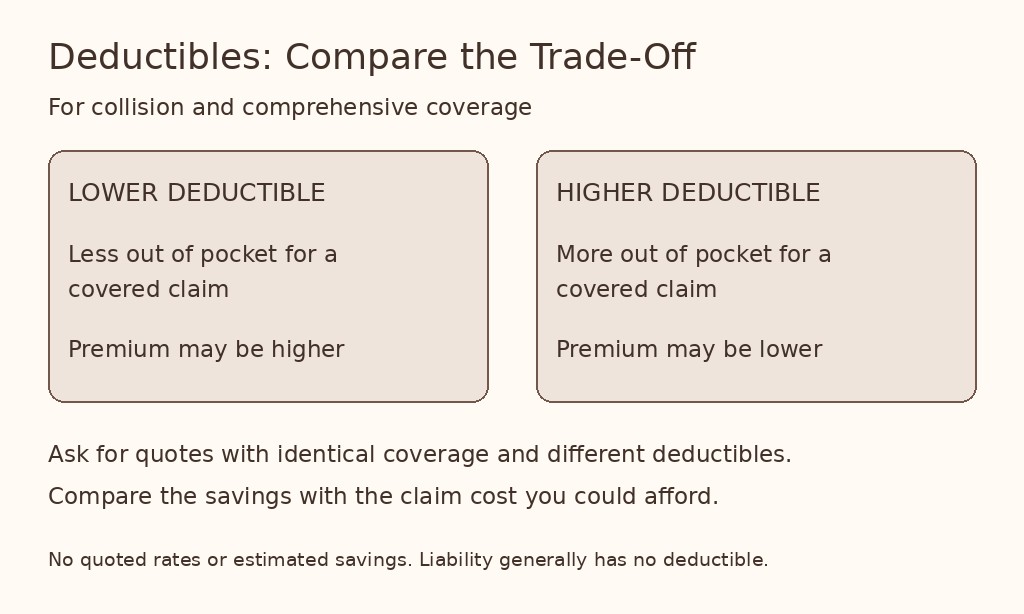
For collision and comprehensive coverage, choosing a higher deductible may lower the premium and sometimes the amount due in each installment. Deductibles generally do not apply to liability coverage, and a higher deductible means paying more out of pocket after a covered claim.
Georgia Rates Vary By City And Region
Car insurance isn’t one-size-fits-all in Georgia. Where you live can affect your upfront and monthly costs because insurers consider local claims, traffic, theft, repair costs, and weather-related losses. Larger-city or coastal ZIP codes may cost more for some drivers, but the result varies by insurer and individual risk profile.
• Atlanta Metro: Traffic density, accident frequency, theft, and repair costs may affect premiums.
• Savannah/Coastal: Storm, flood, and wind-related vehicle losses may affect comprehensive coverage pricing.
• Rural Counties: Lower traffic may help in some areas, while animal collisions and longer repair distances can affect claims.
• College Towns: Local claim patterns and the concentration of younger drivers may influence territorial rates, although each driver is rated individually.
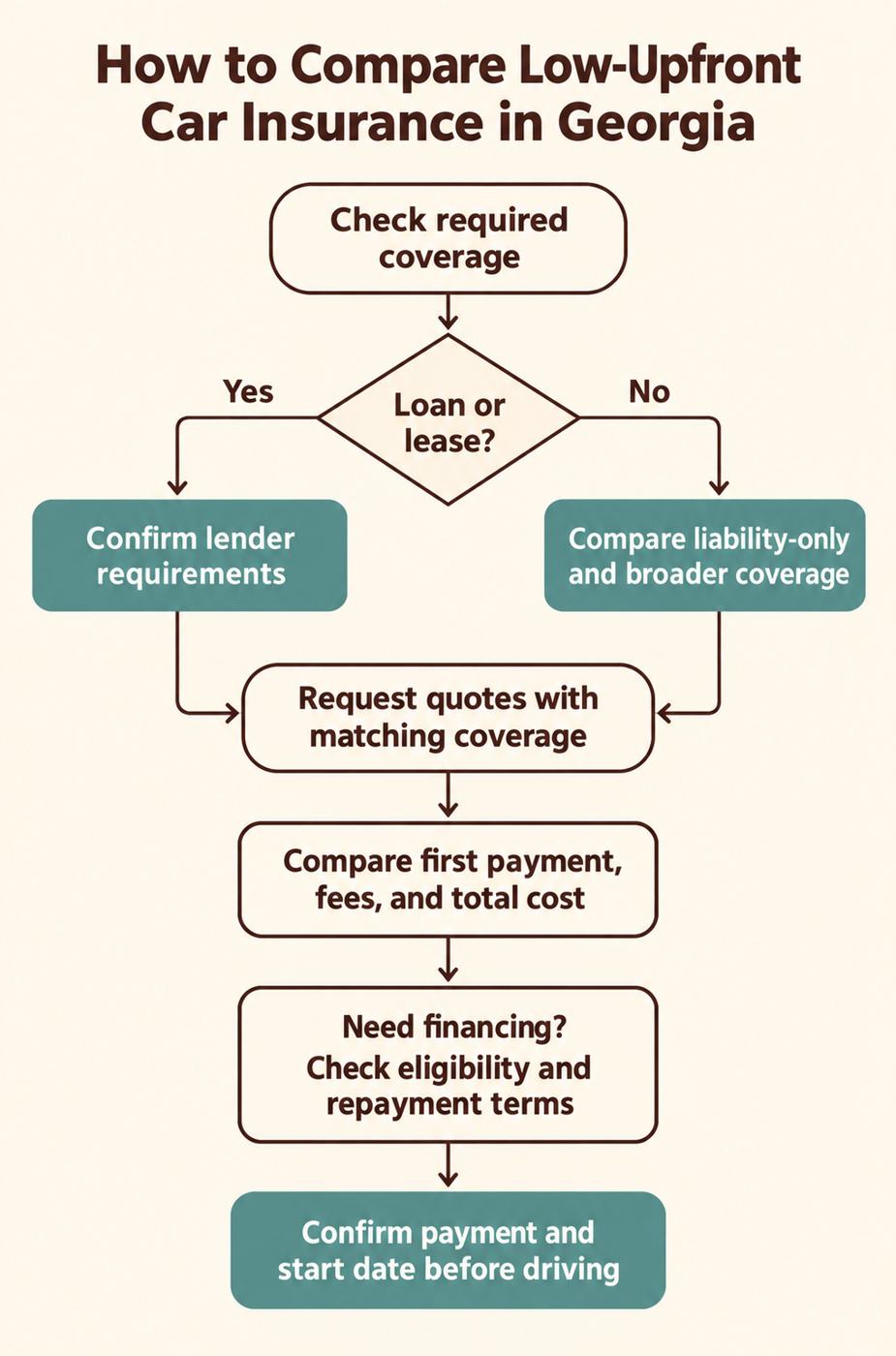
This flowchart is an illustrative decision aid. It is not a quote, guarantee, or confirmation that every listed provider offers every coverage type in each Georgia ZIP code.
Georgia Auto Insurance Coverage Amounts to Consider
| Coverage Component | Georgia Requirement | Higher or Optional Coverage to Discuss |
|---|---|---|
| Bodily Injury (per person) | $25,000 minimum | $50,000–$100,000 is a common higher-limit range to compare |
| Bodily Injury (per accident) | $50,000 minimum | $100,000–$300,000 is a common higher-limit range to compare |
| Property Damage Liability | $25,000 minimum | $50,000–$100,000 may provide more protection for a serious loss |
| Uninsured/Underinsured Motorist | Optional, but insurers generally must offer it | Consider limits that reflect your liability protection and budget |
| Medical Payments | Optional | Amounts such as $1,000–$5,000 may be available |
| Collision | Not required by state law | A lender or leasing company may require it |
| Comprehensive | Not required by state law | A lender may require it; it may help with theft, weather, flood, fire, glass, or animal losses |
Georgia Insurance Lapse and Registration Reinstatement Costs
| Registration Suspension | Lapse Fine | Reinstatement Fee | Fine + Reinstatement Fee |
|---|---|---|---|
| First | $25 | $60 | $85 |
| Second | $25 | $60 | $85 |
| Third or more within five years | $25 | $160 | $185 |
These amounts apply to registration reinstatement after suspension. A lapse alone carries a $25 fine; reinstatement fees apply when registration is suspended. The higher fee applies to three or more suspensions within five years. Other registration fees or taxes may also be due.
Compare Your Written Quotes
| Item to Check | Quote A | Quote B |
|---|---|---|
| Insurer and policy term | Fill in from quote | Fill in from quote |
| Coverage limits and deductibles | Fill in from quote | Fill in from quote |
| Amount due before coverage starts | Fill in from quote | Fill in from quote |
| Total premium for the same policy term | Fill in from quote | Fill in from quote |
| Installment amounts and due dates | Fill in from quote | Fill in from quote |
| Installment and financing fees; total repayment | Fill in from quote | Fill in from quote |
| Cancellation rules and any financing balance | Fill in from quote | Fill in from quote |
| Rideshare coverage, if needed | Fill in from quote | Fill in from quote |
Use written quotes with matching coverage limits, deductibles, and policy terms. If you drive for a rideshare platform, confirm that the policy or endorsement covers that use before buying.
FAQs
A: A separate $0 deposit may be possible for approved applicants through financing or a billing arrangement, but Georgia law still requires advance payment for the first 30 days of motor vehicle liability coverage.[1] A financing provider may pay that amount to the insurer and collect it from you later. Availability and approval vary.
A: For most Georgia-registered personal vehicles, the state relies on the Georgia Electronic Insurance Compliance System (GEICS), and ordinary insurance cards generally are not the controlling proof in the state database. Exceptions and temporary proof rules apply to certain fleet, self-insured, IRP, and recently acquired vehicles, so keep your policy documents and confirm your status through Georgia DRIVES.[3]
A: Do not assume that a grace period applies. Contact the insurer before the due date to ask about payment options or cancellation timing. Georgia requires continuous liability coverage on vehicles with active registration, and 10 or more consecutive uninsured days on the state record can be treated as a lapse.[4]
A: Georgia requires at least 25/50/25 liability coverage: $25,000 bodily injury per person, $50,000 bodily injury per incident, and $25,000 property damage per incident.[2]
A: It may lower the premium for collision or comprehensive coverage, but it also increases what you pay after a covered claim. Liability coverage generally does not use a deductible.
A: Georgia may require an SR-22 or SR-22A after certain violations or suspensions. For a second or subsequent no-insurance suspension, Georgia DDS states that an SR-22A is required and generally must be maintained for three years. These filings can limit payment flexibility, so confirm the exact requirement with Georgia DDS and a licensed insurer.[5]
The Final Word on Cheap Car Insurance in GA With No Down Payment
There’s no magic loophole to get car insurance in GA with nothing down. Georgia requires advance payment for the first 30 days of motor vehicle liability coverage. But that doesn’t mean every driver is stuck with a large separate deposit. The lower-upfront-cost paths may include:
• Liability-only coverage when appropriate and when the vehicle is owned outright.
• Monthly installments that reduce the amount due at one time.
• Higher collision or comprehensive deductibles to lower premiums, if you can afford the larger claim cost.
• Deposit financing for approved applicants who need little or no separate payment at checkout.
• Maintaining continuous coverage to avoid lapse fines and possible registration suspension.
By comparing companies such as Georgia Farm Bureau, Central, Direct Auto, and Good2Go, along with flexible-payment or financing services such as Hugo or OCHO where available, you can look for a lower initial cost without assuming that any company will be cheapest for every Georgia driver.
Now that you know how to compare cheap car insurance in GA with no down payment, it’s time to review rates and payment terms. Compare auto insurance quotes online and check the initial payment, total premium, fees, coverage limits, deductibles, and cancellation rules before purchasing.
References
- Georgia Code § 33-34-3 — advance payment for the first 30 days of motor vehicle liability coverage ↩
- Georgia Office of the Commissioner of Insurance and Safety Fire — Auto Insurance ↩
- Georgia Department of Revenue — Insurance Coverage and Electronic Verification ↩
- Georgia Department of Revenue — Lapse or Loss of Insurance Coverage ↩
- Georgia Department of Driver Services — SR-22A Requirements for Multiple No-Insurance Suspensions ↩
Compare Quotes in 2 Minutes
Secured with SHA-256 Encryption
OUR WEBSITE

TRUST & AUTHORITY


Featured Articles
SEARCH
Looking for something specific? Use the search bar below to find answers to your questions!