
Cheap Car Insurance Under $50 a Month
Do you need car insurance under $50 a month? Compare Cheap Auto Insurance Quotes Online and Save.
Compare Quotes in 2 Minutes
Powered by:

 Secured with SHA-256 Encryption
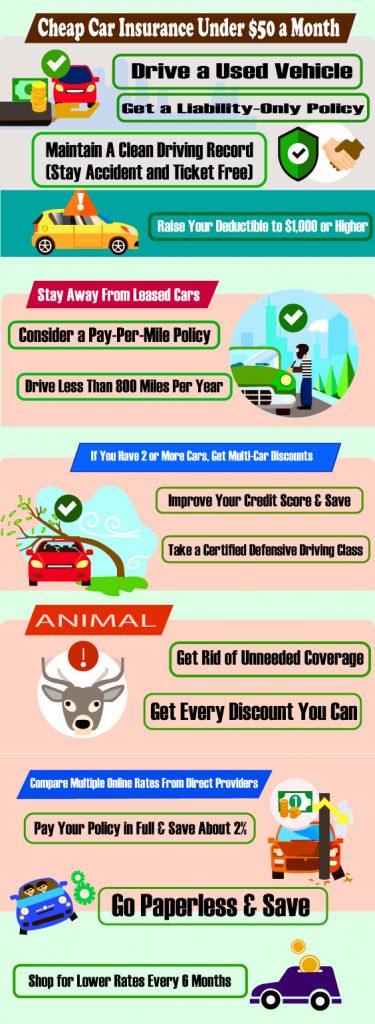
Are you trying to lower your auto insurance rates? Do you need car insurance under $50 a month? If this sounds like you, you can take steps to look for quality coverage, although premiums near $50 a month are generally available only to some drivers, often for liability-only coverage, and are never guaranteed.
Buying auto insurance can be a little overwhelming for many people, and many drivers are unsure what type of policy to get or which limits they should buy. Let’s dig into how to look for cheap car insurance and choose coverage levels that may adequately protect you.
Important: A quoted monthly rate does not necessarily equal the amount due to start a policy. Premiums, initial payments, fees, discounts, eligibility and coverage options vary by insurer, state and driver profile. CitizensInsurance.net is an independent insurance information website and is not an insurance company.
| What a rate near $50 a month may involve | What to check before buying |
|---|---|
| State-minimum or liability-only coverage | Whether the limits are enough to protect your income and assets |
| A clean driving history, lower mileage or a lower-cost vehicle | Whether the quoted price includes all fees and discounts |
| A higher deductible when physical-damage coverage is included | Whether you could afford the deductible after a covered loss |
Be a Safe Driver
Being a safe driver is one of the most important steps toward getting cheap car insurance under $50 a month. You generally need to be classified as a relatively low-risk driver in the eyes of insurers to qualify for the most affordable premiums.
Car insurance premiums are calculated using a driver’s risk profile. One of the biggest factors that goes into the rate a driver pays is their driving history. If someone has a driving under the influence (DUI) conviction or a serious violation such as reckless driving or racing, getting insured for under $50 a month will usually be difficult.
Even having two or more tickets on your record for minor offenses can cause your premiums to rise, although the amount varies by insurer and state. At-fault accidents can also classify you as a higher-risk driver and, you guessed it, cause your premiums to increase. If you get a ticket, check whether you are eligible for an approved traffic school or defensive-driving course. Depending on state law and insurer rules, completing a course may help with the violation or a discount, and the instruction may also make you a safer driver.
How Auto Insurance Costs are Calculated
Understanding what goes into the premiums you are charged can be a little bit complicated, to say the least. There are so many things involved in calculating the car insurance rates you pay, and you have no control over many of these things. Here are just a few things that factor into your rates.
- Your age and, where state law permits, sex or gender
- Driving record
- The vehicle you drive
- Where you live
- Your credit-based insurance score, where state law permits
- Number of miles driven each month
- Whether you own or rent a home
- Safety features on your vehicle
Generally, the less risk you pose to an insurer, the lower your rates will be. The opposite, of course, is also true. The higher the risk you pose, like a new teenage driver with no experience, corresponds with higher rates.
Although you cannot control several things, such as your age and some location-based factors, there are many things you may be able to act on. This includes your credit-based insurance history where its use is permitted, vehicle type, annual mileage, selected coverage and, of course, your driving behavior. These factors may help you qualify for lower premiums and, for select drivers, auto insurance rates near $50 a month.[1] [4]
Liability Car Insurance Under $50 a Month
If you drive a vehicle, you generally must purchase state-minimum liability insurance or otherwise meet your state’s financial-responsibility requirements. Each state has unique automobile insurance laws, including the minimum liability coverage a driver needs to purchase. Many consumers on a strict budget, or those with a paid-off used vehicle they rarely drive, may consider liability-only coverage. State-minimum liability car insurance can sometimes be under $50 a month for qualified drivers, but it may provide limited protection and does not cover damage to the insured driver’s own vehicle.
These liability policies are often referred to as “barebones” insurance coverage. State-minimum liability policies are usually among the cheapest policies you can purchase, and some experienced drivers with clean records may qualify for car insurance under $50 a month, depending on location, vehicle, mileage and other rating factors.
In some markets, motorists with a safe driving record who drive a lower-cost used vehicle and have relatively low monthly mileage may find liability coverage around $50 a month, and occasionally less. There is no universal 800-mile threshold or guaranteed price. In general, the less risky your driving profile appears to an insurer, the more favorable your rate may be.
Insurance rates vary quite a bit between companies, which is why it’s important to compare quotes from several carriers using the same coverage limits and deductibles. This may increase your chance of finding minimum-liability auto insurance around $50 a month. You can check available rates by entering your ZIP code.
Compare Quotes in 2 Minutes
Compare Insurance Quotes and Save!
 Secured with SHA-256 Encryption
Can Teenagers Buy Car Insurance for Under $100 a Month?
Teenagers are among the highest-risk and least-experienced motorists. Teen drivers have a higher fatal-crash rate than many older age groups, mainly because of inexperience, limited driving skills and risky behaviors such as speeding or distraction. Motor vehicle crashes are a serious safety risk for teens, and distracted cell phone use while driving can contribute to preventable crashes.[2]
Some teens text, use social media or interact with other phone features while driving, which is extremely dangerous. Distracted driving, combined with inexperience, can increase crash risk. Because insurers generally price policies according to expected claims risk, teenage drivers are often charged much higher premiums.
Teens generally pay more for insurance coverage because their age group has less driving experience and a higher expected claims risk. So, this brings up a question: is auto insurance under $100 a month even possible for these young motorists? It is usually difficult, but it may be possible in limited situations, especially when a teen is added to a parent’s policy and qualifies for discounts. Where insurers are permitted to use sex or gender in rating, female teen drivers may sometimes receive lower rates than male drivers of the same age, but this is not universal.
Tips That May Bring Down the Cost of Teen Car Insurance
A. Stay on Your Parent’s Auto Insurance Policy When Eligible
This is a crucial tip that may make the difference between a policy near $100 a month and one that costs much more. When insurer and household eligibility rules allow it, parents who add their child to their policy may help the teen pay less than they would for a separate policy.
The problem with this is that many parents can’t afford high-cost teen car insurance, or they might want to teach their teenagers responsibility and require that they pay their share of the premium. In that situation, the family can compare the cost of adding the teen to an existing policy with the cost of a separate policy in the teen’s name. A separate policy can be very expensive and is usually difficult to obtain for around $100 per month.
Teenagers and young adults may be able to remain on a parent’s policy into their 20s when they meet the insurer’s household, vehicle-use and eligibility rules. Doing this may save money over the long run and make auto insurance more affordable for younger drivers.
B. Stay Accident- and Ticket-Free
Teenagers with a clean driving record, even for a relatively short period, may increase their chances of getting cheaper rates at renewal or when comparing policies.
C. Drive an Older, Lower-Cost Vehicle
Teenagers may dream of driving a sports car such as a Corvette or Mustang, but that is financially impractical for most teens. If a teenager needs auto insurance coverage for less than $100 a month, an older, lower-cost vehicle may help. Vehicles that are more than eight years old and have four cylinders and four doors can sometimes cost less to insure, but age, engine size and body style alone do not determine the premium. Examples may include older Ford Taurus, Toyota Camry and Subaru models, depending on the exact year, safety record, repair cost and theft history.
D. Consider a Liability-Only Policy Carefully
Even though it can be risky to buy liability-only coverage for a teenager, it may be one of the cheapest options to compare when the vehicle is paid off. However, liability-only coverage does not pay for damage to the teen’s own vehicle, and a lender or lessor may require collision and comprehensive coverage. Over the long run, adding appropriate liability limits and physical-damage protection may be wise. Do not choose limited state-minimum coverage solely to reach a price target if the limits would leave the household financially exposed.
E. Take a Certified Defensive-Driving Course
One way to improve driving knowledge and possibly get lower rates is by taking an insurer-approved defensive-driving course. You may learn useful defensive-driving techniques, and some insurers offer a discount to eligible drivers. The amount and eligibility requirements vary, so confirm the course with the insurer before enrolling. These instructions could also help you become a safer driver.
F. Good Student Discounts
Are you a student with a grade point average of 3.0 or higher? Some insurers offer a good-student discount based on a B average, GPA threshold, class rank or other academic requirements. The amount varies, so good grades may lower your premium but do not guarantee a specific percentage. If the policy includes collision or comprehensive coverage, choosing a $1,000 deductible may also reduce the premium, but only select a deductible the household could afford after a covered loss.
G. Drive less than 800 miles per month
One of the factors in insurance cost is the amount of mileage a driver accumulates each month. The more you drive, the more you are exposed to the possibility of getting involved in an accident, which may affect your premium. The converse can also be true. If you drive less than 800 miles a month, ask whether the insurer offers a low-mileage or usage-based option. The threshold and potential savings vary by company and state.
H. Get Telematics Discounts
Consider getting covered with a carrier that offers a telematics or usage-based insurance program. A device or mobile app may track mileage and driving behaviors such as braking, acceleration, speed, time of day and phone use. Some safe teen drivers may receive a discount, but not everyone qualifies or saves, and privacy practices vary by program. Taking advantage of these tips may improve your chance of finding lower-cost teen car insurance, but it does not guarantee a rate of $100 a month or less.[3]
Senior Citizen Car Insurance Under $50 a Month
Many mature drivers between the ages of 50 and 65 may pay comparatively low rates, depending on their driving record, location, vehicle and coverage. Some drivers in this age range also drive fewer miles than motorists in other groups, which may lower their exposure to accidents. Rates can rise again at older ages, so age alone does not determine the premium.
Seniors with a clean driving record, favorable rating factors and relatively low mileage may sometimes find car insurance rates near $50 per month. There is no universal credit-score or mileage threshold. Many seniors drive paid-off used vehicles and may choose minimum liability coverage, although they should consider whether the limits are sufficient and whether they could afford to replace the vehicle after a loss. Some seniors may qualify for $50-a-month car insurance with a low deposit, depending on insurer, state, coverage and eligibility.
Tips for seniors include:
- Choosing a deductible of $1,000 or more on collision or comprehensive coverage, if they could afford that amount after a loss
- Reviewing the cost of physical-damage coverage on a lower-value, paid-off vehicle
- Considering whether to drop collision or comprehensive coverage only when the vehicle is paid off and the driver could absorb the loss
Several companies may be worth comparing for mature drivers, although no insurer is cheapest for everyone and availability varies by state. These include:
- The Hartford
- Travelers
- Farmers
- State Farm
- USAA Insurance
- Allstate
Tips on Getting Car Insurance Under $50 a Month
It might sound like common sense, but having a clean driving record with no tickets and no at-fault accidents can go a long way toward lowering your auto insurance premiums. You can influence this factor, so drive safely whenever you get behind the wheel. Where credit-based insurance scoring is permitted, improving your credit history may also help, although there is no universal score of 700 or guaranteed percentage reduction. Drivers trying to reduce the amount due at the start of coverage can also review zero-down or low-upfront-payment car insurance options, while remembering that an approved first premium payment is generally still required.
You also want to review several auto insurance quotes from a variety of insurers. This includes regional and national carriers. Some competitive offers may be found online with direct providers such as Progressive or Esurance, depending on availability. Some insurers advertise low-down-payment or buy-now-pay-later car insurance options, but the amount due usually reflects the first premium installment and may include fees. Qualified drivers may occasionally find liability-only rates around $50 per month, but neither the starting payment nor monthly premium is guaranteed.
Compare Quotes in 2 Minutes Trusted For Over 25+ Years*
The Issue with Minimum Liability Auto Insurance Policies
While everyone wants auto insurance to be as cheap as possible, a minimum-liability policy might cost you more in the long run if its limits are not enough for a serious claim. Why, you might ask? Because low limits can leave a policyholder underinsured. For example, let’s say you had a policy with $60,000 in applicable liability coverage but caused more than $250,000 in covered damages in an at-fault crash.
This could leave you personally responsible for damages above the policy limit, subject to state law and the facts of the claim. It’s important to view insurance as a way to protect income and assets, not only as a monthly expense. Many drivers may benefit from higher liability limits, while collision and comprehensive coverage depend on the vehicle’s value, financing requirements and the driver’s ability to absorb a loss.
Understanding 100/300 Liability Limits
The term 100/300 is commonly used to describe bodily-injury liability limits of $100,000 for one injured person and $300,000 for all injured people in one covered accident. It is not a universal “rule” or the right amount for every driver. Appropriate limits depend on state requirements, assets, income, risk tolerance and budget.
In general, you want to get the most suitable insurance protection you can reasonably afford. This may mean buying higher liability limits that better protect your assets. If you have substantial assets, consider discussing higher auto liability limits and possibly an umbrella policy with a licensed insurance professional. Some safe drivers with a clean motor-vehicle record may find 100/300 coverage near $100 a month, but the price and whether those limits are adequate depend on the individual policy and household.
Companies to Compare for Low-Cost Car Insurance
Several insurers may have low rates for qualified drivers, but no company can guarantee a $50 monthly premium without reviewing the applicant, vehicle, location and selected coverage. Companies and brands to compare may include:
- Esurance, where quoting and coverage are available
- 21st Century, where coverage is available
- Progressive
- USAA, for eligible military members, veterans and qualifying family members
- State Farm
- Erie, in states where it operates
Takeaways on Getting Car Insurance Under $50 a Month
Getting auto insurance for $50 a month is difficult but may be possible if a driver meets the right risk profile and buys limited levels of protection. To improve your chances of finding a lower rate, consider a modest, lower-cost vehicle. A vehicle that is more than eight years old with a four-cylinder engine and four doors may sometimes cost less to insure, but the model’s safety record, repair costs, theft history and selected coverage matter more than age or body style alone.
Check whether the model has a high theft rate in your area. Also, be cautious with luxury vehicles, including used models that may be expensive to repair, such as some Jaguar or Audi vehicles. Used automobiles can cost less to insure in some cases, but not always. Additional anti-theft or vehicle-recovery devices, such as a GPS-based recovery system, may qualify for a small discount with some insurers. The amount varies, and the device does not guarantee a particular savings percentage.
Garage Your Vehicle at Night
Garaging your vehicle may qualify you for a small discount with some insurers or reduce certain location-related risks. Even parking it in a covered or secured space may be considered by some companies, but it will not automatically produce a $50 monthly rate.
Get Every Discount You Can
Discounts may save you money on auto insurance, although the available programs and savings vary. Popular discounts can include:
- Active Military and Veterans Discount
- Teachers Insurance Discount
- Safe Drivers Discount
- Good-student discount, subject to the insurer’s academic requirements
- Mature-driver or approved driving-course discount
- Continuous-coverage discount or favorable rating treatment, where available
Did you know that canceling your insurance policy and going for an extended period without auto insurance can increase your rates with some insurers? Secure a new policy before canceling the older policy so you avoid an unintended lapse in coverage.
Consider a Telematic Device
For drivers of any age, a telematics program may reduce rates when the recorded driving behavior meets the insurer’s criteria. While monitoring may feel intrusive, some drivers consider it worthwhile for the possibility of a discount. Other drivers may receive little or no savings, and program terms should explain what data is collected and how it may be used. Telematics does not guarantee that a policy will fall to $50 a month.
Drive Less than 800 Miles per Month
Whether you’re a young driver under 25 or a senior driver over 60, driving fewer miles may reduce your premium with some insurers because it can reduce exposure to accidents. It is not always that simple, however. If you drive less than 800 miles a month, ask about a low-mileage or usage-based program, but do not assume it will save 20% or produce a $50 monthly premium.
Shop for Car Insurance Under $50 a Month Online
Comparing auto insurance quotes is faster and easier than it once was, thanks to the internet. You can even use your smartphone to compare quotes. In a short online session, you may be able to review offers from multiple insurance carriers.
Shopping for direct auto insurance rates online may help you find policies under $50 a month and save time, but compare the same limits, deductibles and optional coverages. Get started by entering your ZIP code and comparing the plans available to you, including options under $100 a month where offered. Choose the coverage that fits your needs, not only the lowest displayed price.
Pocket-Friendly Policies: Illustrative Insurance-Budget Scenarios
Illustrative Example 1: Derek’s Scenario
Imagine Derek, a retiree in Phoenix, AZ, living on a fixed income. If he found liability-only car insurance for under $50 a month after comparing quotes, the lower premium could free part of his budget for hobbies and time with his grandchildren. Before buying, however, Derek would still need to confirm that the limits were sufficient, that the vehicle was eligible and that the amount due at the start of the policy matched the advertised monthly price. This is a hypothetical example, not a verified customer testimonial or a promise that this rate is available.
Illustrative Example 2: Nicole’s Scenario
Imagine Nicole, a part-time student and barista in Miami, FL, working with a very tight budget. If she qualified for car insurance for less than $50 a month, the lower premium could help her keep the vehicle insured while managing education and living expenses. She would still need to compare the policy’s limits, exclusions, initial payment and deductibles, because an inexpensive policy may provide only limited coverage. This is a hypothetical example, not a verified customer testimonial or a representation that every student can obtain this price.
Frequently Asked Questions
Is Car Insurance Under $50 a Month Guaranteed?
No. A rate near $50 a month may be available to certain low-risk drivers, often for liability-only coverage, but the final premium depends on the insurer, state, vehicle, driving history, coverage and discounts.
Does $50 a Month Mean Only $50 Is Due Today?
Not necessarily. The amount due to start coverage may include the first premium installment, a deposit or other permitted charges. Review the payment schedule before purchasing.
Is Minimum Liability Coverage Enough?
It satisfies the legal minimum in many situations, but it may not provide enough protection for a serious crash and does not pay for damage to your own vehicle. Consider your assets, income, vehicle value and financing requirements before choosing limits.
References
- National Association of Insurance Commissioners, Auto Insurance. Source ↩
- National Highway Traffic Safety Administration, Teen Safe Driving: How Teens Can Be Safer Drivers. Source ↩
- National Association of Insurance Commissioners, Want Your Auto Insurer to Track Your Driving? Understanding Usage-Based Insurance. Source ↩
- National Association of Insurance Commissioners, Credit-Based Insurance Scores. Source ↩
Compare Quotes in 2 Minutes
Secured with SHA-256 Encryption
OUR WEBSITE

TRUST & AUTHORITY


Featured Articles
SEARCH
Looking for something specific? Use the search bar below to find answers to your questions!